Matcha Green Tea: How Much Caffeine? (Sept 2026)
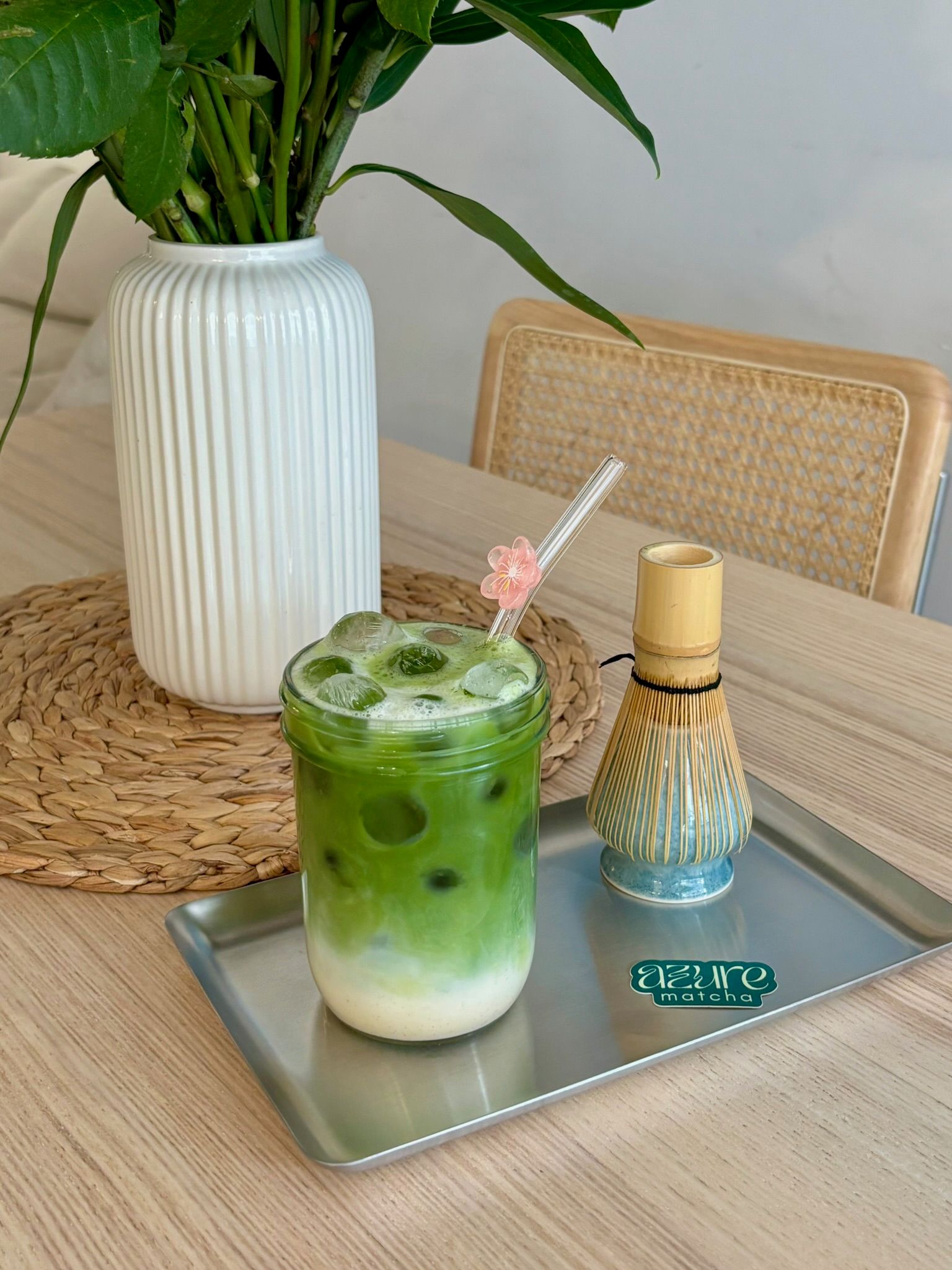
So you switched to matcha for calmer, steadier energy and now you're wondering exactly how much caffeine you're working with. Fair question. The short answer: it depends on your scoop size more than anything else, and we can break down exactly what that looks like.
TLDR:
- A standard 3g matcha serving contains roughly 57 to 132 mg of caffeine, more than steeped green tea (30 to 50 mg).
- L-theanine in shade-grown matcha slows caffeine absorption, producing steadier alertness without a hard crash.
- Your dose in grams determines caffeine content more than latte vs. bowl format or grade.
- Up to 400 mg of caffeine daily is considered safe for most healthy adults, leaving room for four to six servings.
- Azure Matcha's first-flush Okumidori and Saemidori blend, shade-grown for four weeks, sits toward the higher end of that range.
How Much Caffeine Is in Matcha Green Tea
A standard 3g serving of matcha contains somewhere between 57 and 132 mg of caffeine, though that wide range reflects real variables: grade, growing conditions, and serving size all pull that number in different directions. A lighter 2g scoop lands closer to the low end; a 4 to 6g preparation pushes it higher.
Published figures vary considerably across sources, so treat any specific number as a working estimate. What stays consistent is that matcha caffeine content runs meaningfully higher than regular steeped green tea, and how you prepare it matters as much as the powder itself.
Why Matcha Has More Caffeine Than Regular Green Tea
Both matcha and regular green tea come from the same plant, Camellia sinensis. The difference is in how the leaf is grown, processed, and consumed.
Matcha plants are shade-grown before harvest, which pushes the leaf to produce more chlorophyll and accumulate higher caffeine levels. The leaf is then stone-ground into a fine powder, whisked directly into water and consumed whole. With steeped green tea, the leaves are soaked and discarded, so you extract only a fraction of what the leaf contains. A typical 8-ounce cup of green tea yields 30 to 50 mg of caffeine. With matcha, you consume the entire leaf, and the caffeine content reflects that.
Matcha Caffeine vs. Coffee Caffeine
A standard matcha serving lands around 60 to 70 mg of caffeine, placing it well below a typical cup of drip coffee but roughly on par with a single shot of espresso. Coffee ranges widely depending on roast and brew method, so treat all of these as reasonable working estimates, not fixed values.
- Matcha (standard serving) — Caffeine (approx.): 60 to 70 mg
- Drip coffee (8 oz) — Caffeine (approx.): 95 to 100 mg [source]
- Espresso (single shot) — Caffeine (approx.): 60 to 65 mg [source]
Why Matcha Caffeine Feels Different Than Coffee
L-theanine is an amino acid found naturally in tea leaves, concentrated especially in shade-grown varieties. When paired with caffeine, it slows absorption and produces a steadier, more gradual energy release: focus without the sharp spike that often comes with coffee, and without the equally sharp drop afterward.
Research published in PMC supports what most regular matcha drinkers already notice: a calmer, more even alertness. Shade-growing concentrates both caffeine and L-theanine in the leaf, which is part of why this effect tends to be more pronounced with matcha than with standard steeped green tea.
What Affects Caffeine Content in Matcha
Several variables explain why matcha caffeine ranges so widely across sources, even when you're using the same scoop size.
- Serving size: a 2g scoop and a 6g scoop are not interchangeable. Doubling your dose roughly doubles your caffeine intake.
- Harvest timing: first-flush leaves, picked in early spring, tend to accumulate more caffeine than leaves from later harvests.
- Shade duration: longer shade periods push the plant to produce more caffeine as a natural response to reduced light.
- Cultivar: different varieties of Camellia sinensis carry different baseline caffeine levels regardless of growing conditions.
- Preparation: more powder, less water, or a longer whisk time all concentrate what ends up in your cup. See the three minutes that make the cup for more on technique.
Grade alone does not tell the whole story. Two matchas at the same scoop weight can still differ meaningfully if one is a first harvest, long-shaded leaf and the other is a later-harvest, lightly shaded one.
How Much Matcha Caffeine Is Too Much
The Mayo Clinic notes that up to 400 mg of caffeine per day appears safe for most healthy adults. At a standard 60 to 70 mg per serving, that leaves room for four to six cups of matcha before approaching that threshold, depending on how strong you prepare each one.
Individual tolerance varies considerably. Pregnancy, caffeine sensitivity, certain medications, and general health all shift what a reasonable daily amount looks like. If you are pregnant, breastfeeding, or have a known sensitivity, checking with a healthcare provider before adding matcha regularly is the straightforward move.
Who Should Choose Matcha Over Coffee for Caffeine
Matcha is a reasonable fit if coffee tends to leave you jittery, anxious, or wired followed by a hard crash. The L-theanine and caffeine pairing produces a more gradual curve, which suits people who want alertness without the volatility.
That said, matcha is not a low-caffeine option. A well-prepared serving carries real caffeine, and if you are genuinely sensitive to it, swapping coffee for matcha may help, but will not eliminate the effect entirely. It is a different delivery mechanism, not an absence of the compound.
People who tend to do well with matcha over coffee include:
- Those who get anxious or shaky from coffee but still want a morning lift
- Anyone who notices a hard energy crash mid-morning after drip coffee
- People looking to moderate total daily caffeine without giving it up completely
- Those who find coffee disrupts sleep when consumed in the afternoon
If you are strictly caffeine-sensitive across the board, matcha still warrants caution. Scale down the serving size and see how your body responds before making it a daily habit.
Caffeine in a Matcha Latte vs. a Traditional Bowl
Milk, oat or otherwise, does not dilute caffeine. What changes the number is how much powder goes into the cup.
A matcha latte made with 2g of powder will carry roughly half the caffeine of a traditional bowl prepared with 4 to 6g. If your cafe uses a single 2g scoop for their latte, you are getting a lighter caffeine load regardless of how large the drink looks in the glass.
Traditional bowl preparation, like the Azure Classic, tends to use more powder, which is why it often delivers a stronger, more focused effect. If you are tracking your caffeine intake, the question to ask is not "latte or bowl" but "how many grams of matcha went in". Our Azure recipes list the exact dose for each preparation.
Azure Matcha and Caffeine Transparency
The Azure Premium Blend, built from Okumidori and Saemidori cultivars shade-grown for four weeks and harvested in the first flush from farms across Uji, Kagoshima, and Shizuoka, tends to place caffeine content toward the higher end of what matcha delivers. Our working estimate follows the range covered earlier: approximately 57 to 132 mg per 3g serving, pending lab confirmation.
Our recommended dose runs 3 to 6g depending on preparation. The Azure Premium Blend 30g tin is a good starting point, with a lighter 3g cold-whisked bowl sitting toward the lower end. Push to 5 or 6g for a more traditional preparation and you move up accordingly. The Azure Premium Blend 80g refill suits that kind of daily use. Knowing your dose in grams is the clearest way to track what you are consuming.
Final Thoughts on Matcha Green Tea Caffeine Content
The numbers only tell part of the story. Matcha caffeine content varies, but what most people notice first is how it feels: steadier, calmer, without the hard drop. Weigh your dose, track how you feel, and let that be your guide.
FAQ
How much caffeine is in matcha compared to a cup of coffee?
A standard matcha serving contains roughly 60 to 70 mg of caffeine, compared to 95 to 100 mg in a typical cup of drip coffee. The more meaningful difference is how the caffeine behaves: matcha's L-theanine slows absorption and produces a steadier energy curve, while coffee tends toward a sharper spike and a harder drop.
Does the Azure Premium Blend have more caffeine than other matchas?
Yes. See the Azure Matcha and Caffeine Transparency section above for cultivar details and our working estimate.
What actually determines how much caffeine is in your cup of matcha?
Serving size is the biggest lever: a 2g scoop carries roughly half the caffeine of a 5g preparation. Beyond that, harvest timing, shade duration, cultivar, and growing region all shift the baseline, which is why published figures vary so widely. Grade alone is not a reliable predictor.
Should I choose matcha over coffee if caffeine makes me jittery?
Matcha is worth trying if coffee tends to leave you anxious or shaky, since the L-theanine and caffeine pairing produces a more gradual release. That said, matcha is not a low-caffeine option. A well-prepared serving carries real caffeine, so if you are broadly sensitive to it, scaling down your serving size first is the practical starting point.
How do I know how much caffeine is in a matcha latte vs. a traditional matcha bowl?
Check the gram dose, not the drink format. See the latte vs. bowl section above for a full breakdown.